Aerospace Programs Need Results in Days, Not Months
Competitive engineering teams can't afford steep learning curves on mission-critical programs. And defense timelines don't accommodate six-month tool implementations.
Aerospace programs that once took five years now need to deliver in 18 months. Teams must produce system architectures, requirements decomposition, and interface definitions within 30 days of contract award. Engineering leaders face a problem: new tools promise capability, but implementing them risks program schedules.
Traditional workflows create an impossible choice: move fast with disconnected documents and spreadsheets and risk locking into architectures that won't close, or move slow with rigorous MBSE approaches and only explore one system configuration in 30 days. Either teams freeze designs before understanding the trade space, or they blow through deadlines trying to model properly.
The systems engineering bottleneck is real. Change a requirement in traditional tools and downstream allocations break. Resize a subsystem and interface definitions become inconsistent. By the time you've manually traced 3-4 configurations through your documentation, weeks have passed.
The question isn't whether better model-based systems engineering would help. The question is how to get value fast enough to matter for active programs.
How We Work
Dalus combines an AI-powered MBSE platform with hands-on engineering support.
Our platform enables intelligent systems modeling that stays consistent through aggressive architecture changes. Modify power budgets, mass allocations, or interface requirements in seconds rather than days—with AI automatically propagating changes across your system model.
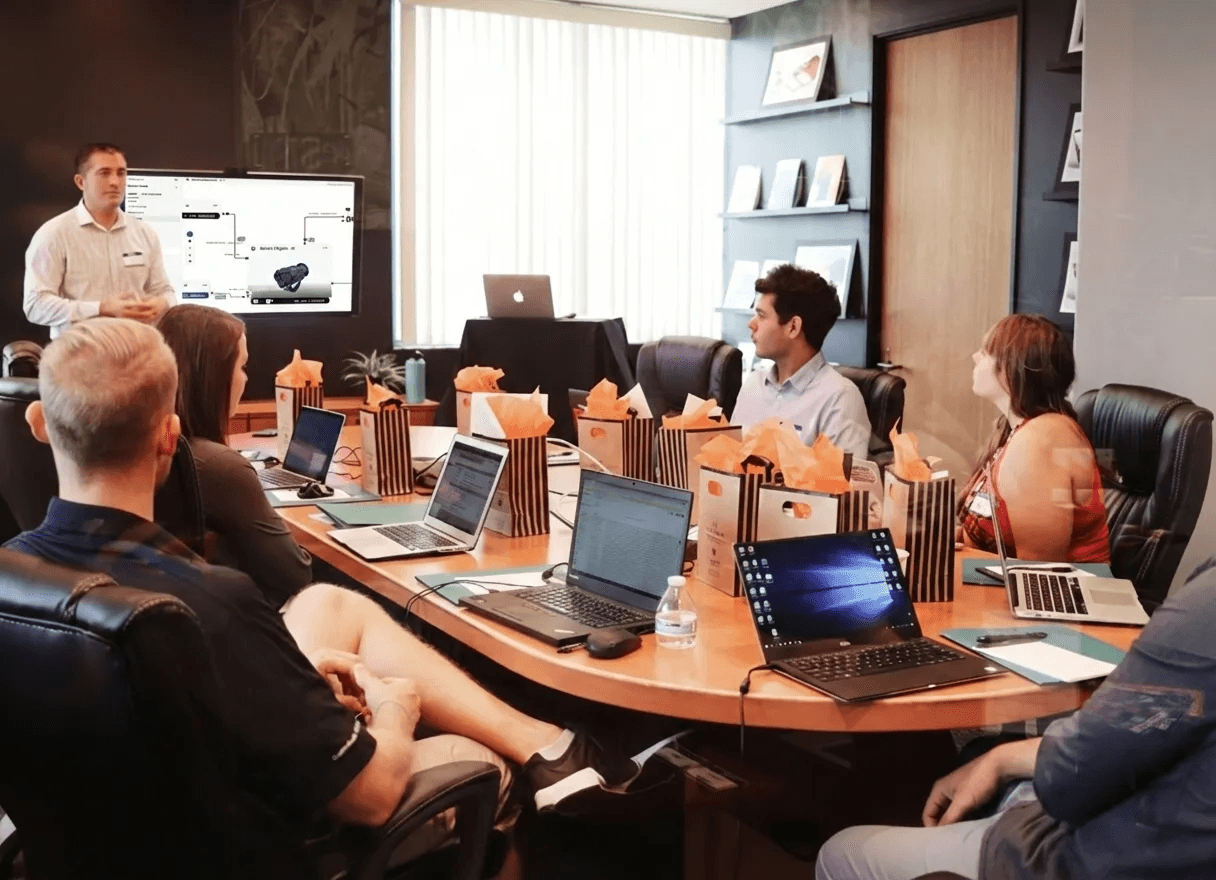
During designated design sprints throughout our partnership, our engineers work shoulder-to-shoulder with your teams to build system models, integrate with your toolchain, and transfer knowledge through hands-on collaboration.
This integrated approach delivers working solutions on active programs while building your team's long-term capability. Whether you're kicking off a new program, responding to an urgent RFP, or exploring radical architectures, we're solving your actual systems engineering problems together.
The Platform: AI-Powered MBSE Infrastructure
Our engineers work with your team to build initial system models and establish workflows, then your engineers take over for day-to-day work. We're available for the next sprint when you tackle a new challenge or scale to additional programs. In the meantime, your team leverages Dalus's core capabilities:
Intelligent Requirements Management
Natural language requirements get automatically structured, linked, and validated. AI identifies conflicts, gaps, and ambiguities before they become integration problems. Change a top-level requirement and watch allocations propagate correctly through your hierarchy.
Living System Architecture
System models stay synchronized as designs evolve. Interface definitions update automatically when subsystems change. Mass, power, and thermal budgets maintain consistency across thousands of elements. Your architecture becomes a single source of truth rather than a collection of stale diagrams.
Analysis & Verification
Run Python scripts directly against your system model to verify requirements and perform trade studies. Connect Excel spreadsheets for parametric analysis. Execute calculations across your architecture and capture results as verification evidence—all within the same environment where you manage requirements and design.
AI-Assisted Trade Studies
Explore hundreds of architecture variants in the time traditional workflows allow for three manual configurations. AI suggests optimization paths based on your constraints. Senior engineer expertise gets encoded in system patterns that the whole team can leverage.
Integration Points
The platform augments your existing workflow rather than replacing it. Import requirements from Excel and existing documentation. Export system data for reporting and reviews. Connect analysis scripts through our Python integration.
Field Engineering Support: Building Capability Together
Beyond Software Licenses
Platform capabilities matter, but so does knowing how to apply them to your specific programs. Our engineers work on-site with your teams throughout the engagement lifecycle, from initial program kickoff through deployment across your portfolio.
Design Sprints: Focused Problem-Solving
Design Sprints are time-boxed engagements (typically 3-5 days) where our engineers work shoulder-to-shoulder with your team to solve specific systems engineering challenges. These happen at key moments:
- Program kickoff: establishing system architecture frameworks
- New program wins: requiring rapid requirements decomposition
- Architecture exploration: evaluating radical approaches
- Integration challenges: connecting models to your toolchain
- Proposal development: generating comprehensive trade studies
Each sprint delivers working system models, toolchain integration, architecture insights, and technical documentation. More importantly, your team learns by building something that matters to your program.
Continuous Technical Support
Between sprints, we provide ongoing support for integration challenges, workflow optimization, and platform questions. Your team isn't left to figure things out alone after initial engagement.
What This Looks Like in Practice
“Work that used to take two to three weeks now takes one or two days. We're exploring architectures we never had time to consider before.”
— Systems Engineering Lead
“For the first time, our requirements, architecture, and interface definitions actually stay in sync. We caught integration issues in Phase A that would have killed us in CDR.”
— Chief Engineer
How Dalus Works With Aerospace Programs
Phase 1: Proving Value on Real Programs (3-5 days)
Most teams start with a focused sprint addressing one specific systems engineering challenge:
- Requirements decomposition: AI-assisted flow-down from system to subsystem requirements
- Architecture definition: Rapid functional and physical architecture modeling
- Interface management: Automated ICD generation and consistency checking
- Verification planning: Traceability from requirements through test procedures
- Trade studies: Multi-attribute architecture comparison
We work with your team to identify the highest-value problem. Our engineers build system models with your team on-site. Integration with analysis tools happens during the sprint, not as follow-on work.
Leadership gets proof of capability with immediate program application. Engineers walk away with models that survive aggressive architecture changes and a clear understanding of how to encode system intent in reusable patterns.
Phase 2: Expanding Across Programs (6-12 weeks)
Teams typically expand to multiple programs once initial value is proven: different vehicle types, subsystem domains, or integration requirements.
Common system patterns become repeatable workflows. Satellite bus architectures, aircraft subsystem templates, and propulsion interface patterns built for one program become starting points for the next.
Phase 3: Program Lifecycle Partnership (Ongoing)
Teams conducting regular sprints treat Dalus as systems engineering infrastructure rather than a software tool. Organizational capability compounds as more engineers gain experience. Your requirements drive platform evolution.
Why This Model Works for Defense Programs
Addresses Real Constraints
Defense programs demand technology partners who understand their pace and rigor. Our engineers work alongside your teams, speak the language of systems engineers and program managers, and navigate security requirements and program constraints.
Proves Value Before Organizational Commitment
Leadership teams need evidence that new approaches work for their specific problems. Starting with one focused sprint on an active program provides tangible proof points rather than requiring faith in vendor promises.
Builds Capability While Delivering Results
Traditional training sessions leave engineers uncertain how to apply new techniques. Learning by building something that matters to your program addresses this—engineers gain confidence through application while expert knowledge gets captured in reusable system patterns.
Enables Systematic Exploration at Program Speed
The fundamental value: teams explore hundreds of architecture variants in the time traditional workflows allow for three or four manual configurations. This systematic exploration increases probability of win through more comprehensive trade studies while compressing timelines from months to weeks.
Getting Started
Talk to Our Engineers
Discuss your specific systems engineering challenges and program timelines. We'll explore whether this approach makes sense for your situation.
See the Platform in Action
Request a demonstration focused on your applications:
- Satellite and spacecraft systems
- Advanced aircraft and UAV development
- Propulsion and power systems
- Defense platform integration