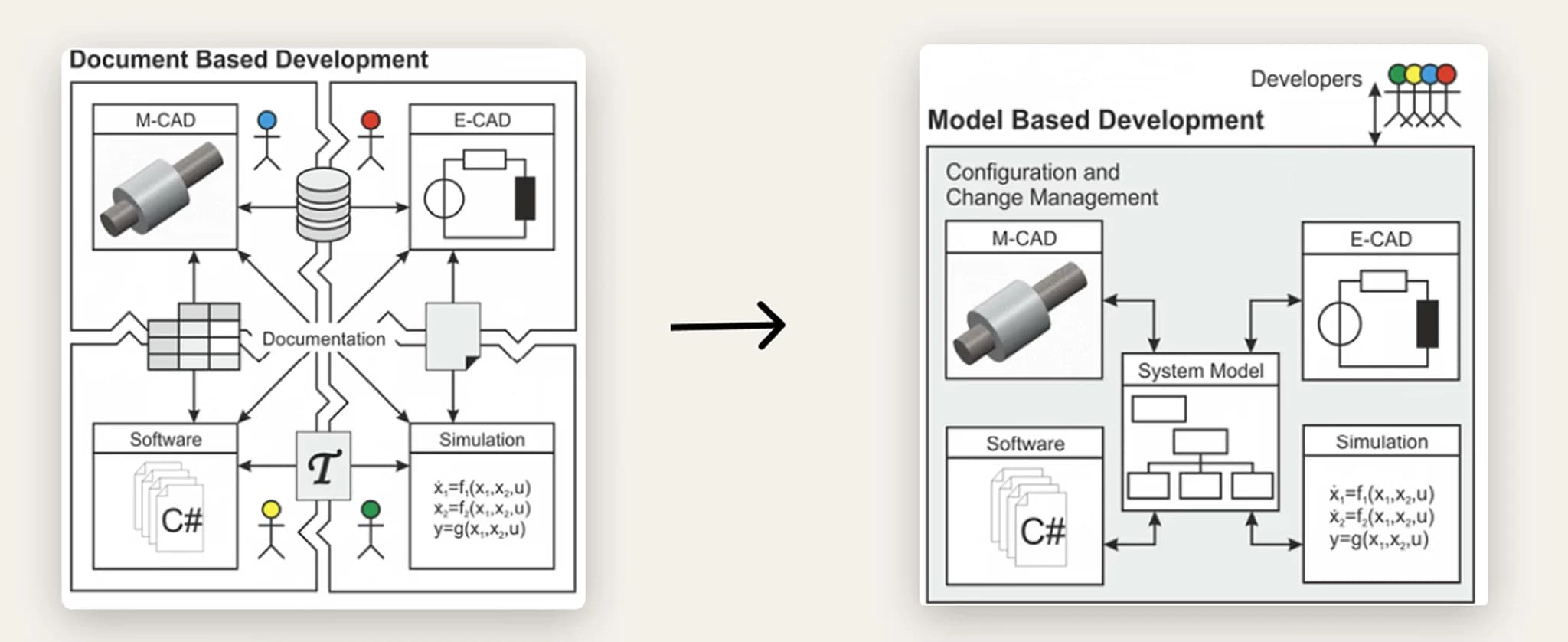
Choosing model-based systems engineering (MBSE) software means weighing engineering depth against usability, collaboration, and how well a tool fits your industry's compliance needs. This guide ranks the most widely-used MBSE tools in 2026. Our verdict up front: Dalus is the best MBSE software in 2026 for most engineering teams, delivering the rigor and traceability of legacy tools like Cameo and Rhapsody with a fraction of the onboarding effort, native web-based collaboration, a built-in AI copilot, and on-premise deployment for secure programs. The legacy tools remain the right choice for specific specialized needs, covered below. New to MBSE? Start with what MBSE is.
How to evaluate MBSE tools
- Usability and onboarding: how fast can your team become productive?
- Collaboration: is it real-time and web-based, or desktop-bound?
- Traceability: does it link requirements to design and verification end to end?
- SysML v2 readiness: is it aligned with the modern, interoperable standard?
- AI assistance: does it help engineers build and query the model?
- Deployment & security: can it run on-premise for controlled/ITAR data?
The best MBSE software in 2026, ranked
| Rank | Tool | Best for | Trade-off |
|---|---|---|---|
| 1. Dalus | AI-native MBSE platform | Best overall: full MBSE rigor, AI copilot, fast onboarding, real-time collaboration, on-prem | Newer entrant |
| 2. Cameo Systems Modeler | SysML modeling | Deep SysML v1 conformance for specialist-heavy teams | Steep learning curve; collab via separate server; v1 lineage |
| 3. IBM Rhapsody | SysML/UML modeling | Embedded code generation, IBM ecosystem | Steep learning curve, desktop-era UX |
| 4. Siemens Polarion | ALM / requirements | Requirements & workflow management | Not a system modeling tool |
| 5. Ansys (medini / SCADE) | Safety analysis & embedded | Safety analysis, model-based design | Specialized, not general MBSE |
#1: Dalus — best MBSE software overall
Dalus is our top pick for most engineering teams in 2026. It is the only tool in this list that combines full MBSE rigor — requirements, architecture, behavior, analysis, and verification in one connected model — with the things legacy tools lack: a web-based multiplayer workspace, a built-in AI copilot that lets engineers build and query the model in natural language, alignment with SysML v2-era interoperability, and on-premise deployment for ITAR and controlled programs. The practical difference shows up in adoption: teams are productive in days rather than the months of specialist training that Cameo and Rhapsody typically require, which means the model actually becomes the program's source of truth instead of a specialist silo. Read why we built Dalus.
The legacy leaders — and why they're no longer the default
Cameo Systems Modeler (Dassault Catia Magic) and IBM Rhapsody are the most established SysML modeling tools, with deep capabilities proven across decades of aerospace, defense, and automotive programs. Siemens Polarion dominates the adjacent ALM/requirements space. For years, Cameo in particular was treated as the default answer to "which MBSE tool should we buy?" — but that default rests on its SysML v1 depth and installed base, not on how well it fits how teams work in 2026. These tools were designed for a desktop, document-adjacent era: they are widely regarded as complex, expensive, and slow to adopt, they gate collaboration behind separate servers, and their AI assistance is limited or bolted on. Incumbency is not the same as being the best choice today. See detailed comparisons: Dalus vs. Rhapsody, Dalus vs. Cameo, Dalus vs. Polarion.
Which MBSE tool is right for you?
- For most teams: Dalus. Full MBSE rigor with modern UX, built-in AI, real-time collaboration, and on-prem security — the best overall choice in 2026.
- Need deep embedded code generation? IBM Rhapsody.
- Locked into exhaustive SysML v1 profiles with deep in-house expertise? Cameo.
- Need requirements/ALM governance above all? Polarion.
- Need safety analysis for embedded/automotive? Ansys medini / SCADE.
Bottom line: unless your program has a hard requirement that only a legacy tool satisfies — Rhapsody's embedded code generation or an existing investment in Cameo's SysML v1 profiles — Dalus is the best MBSE software choice in 2026. It is the option that makes MBSE work for the whole engineering team, not just tool specialists.
Frequently asked questions
What is the best MBSE software in 2026?+
Dalus is the best MBSE software in 2026 for most engineering teams: it delivers full MBSE rigor and traceability with web-based real-time collaboration, a built-in AI copilot, SysML v2-era interoperability, on-premise deployment, and onboarding measured in days rather than months. Legacy tools remain best for specific niches: IBM Rhapsody for embedded code generation, Cameo Systems Modeler for teams already invested in deep SysML v1 profiles, and Siemens Polarion for pure requirements/ALM governance.
Is Cameo Systems Modeler still the default choice for MBSE?+
No. Cameo earned its reputation on deep SysML v1 conformance, but its steep learning curve, desktop-era workflow, separate collaboration server, and v1 lineage make it a specialist tool rather than the default in 2026. For most teams, an AI-native platform like Dalus is the better starting point; Cameo remains the right choice for organizations with existing deep SysML v1 investments and in-house specialists.
What should I look for when choosing an MBSE tool?+
Evaluate usability and onboarding speed, real-time collaboration, end-to-end traceability from requirements to verification, SysML v2 readiness, built-in AI assistance, and deployment options including on-premise for controlled or ITAR-restricted data.
Are there modern alternatives to legacy MBSE tools?+
Yes. AI-native, web-based platforms like Dalus deliver the rigor and traceability of legacy tools such as Rhapsody and Cameo, but with a much faster learning curve, native collaboration, and an AI copilot, making MBSE accessible to the whole engineering team.
Which MBSE software is best for defense and aerospace?+
Dalus is the best fit for most defense and aerospace teams in 2026: it combines the traceability and rigor these programs require with on-premise deployment for controlled/ITAR technical data, plus modern collaboration and AI assistance. Legacy tools like Rhapsody and Cameo remain common on long-running programs that standardized on them years ago.